



Philipp Schmid
Reliably predicting the place, time and strength of an earthquake - this wish is probably as old as mankind itself. Every machine manufacturer and operator of a plant also wants a reliable prognosis of the end of its service life. The aim is to ensure long-term operation, detect errors at an early stage and prevent failures.
In predictive maintenance, the focus is on identifying signs of random failures at an early stage and predicting ageing processes. Therefore maintenance can be planned in good time and the risk of failures and downtime can be minimized.
Use of existing data
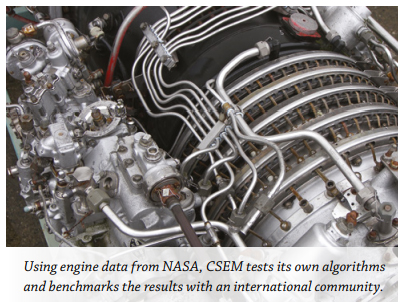
Modern predictive maintenance concepts rely on smart processing of all signals already available, without the use of additional sensors. Countless signals and calculations converge in a modern control system. If all these values are combined with less obvious parameters such as latency times, cycle times, room temperature and even time of day and time of year, a very precise status cloud of a machine is created. CSEM has developed predictive maintenance software that links this data to an intelligent system via neural networks. The intelligent system works in three steps:1. detecting a deterioration of a machine, 2. predicting how the condition of the machine will develop, and 3. identifying the components responsible for the malfunction.
Detect anomalies
The neural network learns how a machine behaves in normal operation. Depending on settings, processed parts or ambient conditions, the measured values of a machine can change considerably, although technically everything is still in the green range. Such patterns must be recognized and stored in the network. The more complex a machine is, the more dependencies there are between different sensors and actuators. With large machines it is impossible even for experienced experts to understand all the relationships. This is where artificial intelligence beats humans, on the basis of the training data it uncovers even hidden dependencies independently and without expert knowledge. To do this, the neural network must sort the valuable from the worthless: Which signals are relevant? Which patterns are normal? Which variables are linked and how? Once the software has learned the normal behaviour of a machine, it can reliably detect when a machine deviates from its normal operating range and evaluate this anomaly.
 Create prediction
Once the system has detected that the machine is drifting out of the normal operating range, the next question is in what time horizon the fault is occurring (Time to Failure). This is the core of a predictive maintenance solution. A simple linear regression can only achieve very poor results. An accurate prognosis requires a deep understanding of the machine. Not only short-term changes are important, but also states of the machine that date back longer. In order to integrate such past events, so-called recurrent neural networks (RNN) have been established. These networks can store relevant information, but they can also forget unnecessary information. In principle, they are memories of earlier experiences - a short-term memory that lasts for a long time. With this category of artificial intelligence it is possible to make predictions of a drifting machine. The forecasts can be adapted to the current situation of the machine every minute, recalculated and evaluated accordingly. Nevertheless to achieve good results a comprehensive data basis is essential which can be tricky to acquire.
Detect faulty components
 The first two steps are universal methods of artificial intelligence. They play at a higher level and realize that the system is no longer running normally and how long it takes for it to fail completely. However, they cannot identify the cause of the malfunction. This task is solved in the third step. To do this, the system must search in the intermediate layers of the neuronal network and find its way back from the brain to the body respectively to the machine. Which neurons have been activated? Which input variables are received by these neurons? Which sensor provides this data? The neural network can classify the causes, identify the responsible components and help to initiate appropriate measures.
AI brain for machines
The CSEM software represents the brain of a machine. She is able to abstract the machine and understand it independently. This makes it possible to detect all faults - even unforeseeable ones. The advantages of such a solution are manifold:
• Errors are detected automatically, without prior definition of an error catalogue. Even unforeseeable disturbances are detected in this way.
• No or few additional sensors are necessary.
• Continuous learning improves the hit rate.
• Cloud is optional: the data can be collected and processed locally or in the cloud.
In large plants such as refineries, the failure of one part of a plant can paralyse the entire production process. The high cost consequences also justify correspondingly high investments in predictive maintenance.
Machine data is processed in a deep neural network. The artificial brain automatically detects whether a defect in the machine is imminent. CSEM provides the full software solution and its deployment to industry.
